The data from 2025 is clear: the gap between backup promises and recovery outcomes is widening. This puts more pressure on your recovery plans to answer two basic questions fast: can you restore clean systems, and can people reach them when the primary network is not safe to use.
In this issue, we share what 2025 reporting means for your recovery planning, a real-world recovery where we brought critical systems back within 24 hours, and a recent Cohesity FortKnox Cleanroom deployment that added a third recovery option for a customer with an existing DR site.
Wishing you a strong start to 2026,
– Nudrat Majid, Customer Success Manager
2026 Recovery Trends and Lessons From 2025
2025 did not change the goal of ransomware, but it exposed where many organizations’ recovery plans fail. Ransomware is now the centerpiece in 44% of breaches (Verizon, 2025) – Meanwhile average recovery times continue to exceed 100 days (IBM). This three-month gap rarely comes from slow restores. It happens when teams cannot verify that restored data is clean, or when the primary network cannot safely carry failover traffic. Another hard lesson from incident reporting is repeat risk – 83% of organizations that paid the ransom were attacked again.
Three priorities keep showing up in incident reporting and postmortems:
Clean recovery: Set up a quarantined area to validate data and access paths before moving systems back into production.
Network reachability: A running VM offers no value if users and integrations cannot reach it. You need failover connectivity that does not depend on a compromised network.
Cloud independence: If an attack locks a specific tenant or control plane, you need the ability to recover in a separate, isolated environment.
Recovery Corner: 24 Hour Restore After a Stalled Recovery
Following a ransomware incident, an organization in the energy space was unable to recover their data for 7 days. Stage2Data stepped in and restored the essential servers within a day. That gave the customer a stable path forward, including a five-month production run in our cloud while they rebuilt and sanitized their primary site.
Our NRaaS™ service preserved the network identity and access patterns at the recovery site, eliminating the need for manual workarounds during the outage window. When missing systems surfaced outside the original replication set, we restored additional VMs from archive backups. Once the primary side was read, Zerto then supported a phased failback.
Success Story: Cohesity Cleanroom as Third Recovery Site
A long-time Cohesity customer already possessed a private DR facility but required a third recovery option for compromise scenarios, specifically events where the network cannot be trusted.
Stage2Data deployed a Cohesity Cleanroom to support controlled validation and restore workflows outside the primary recovery path. This is a practical add-on for clients who already back up effectively but need a separate, isolated environment to prove clean recovery.
How resilient is your cloud against ransomware attacks?
Cyber Risk Intelligence Report
Please provide the following details and we will send you a free Risk Intelligence Report. This will help to identify vulnerabilities in your current cyber security.
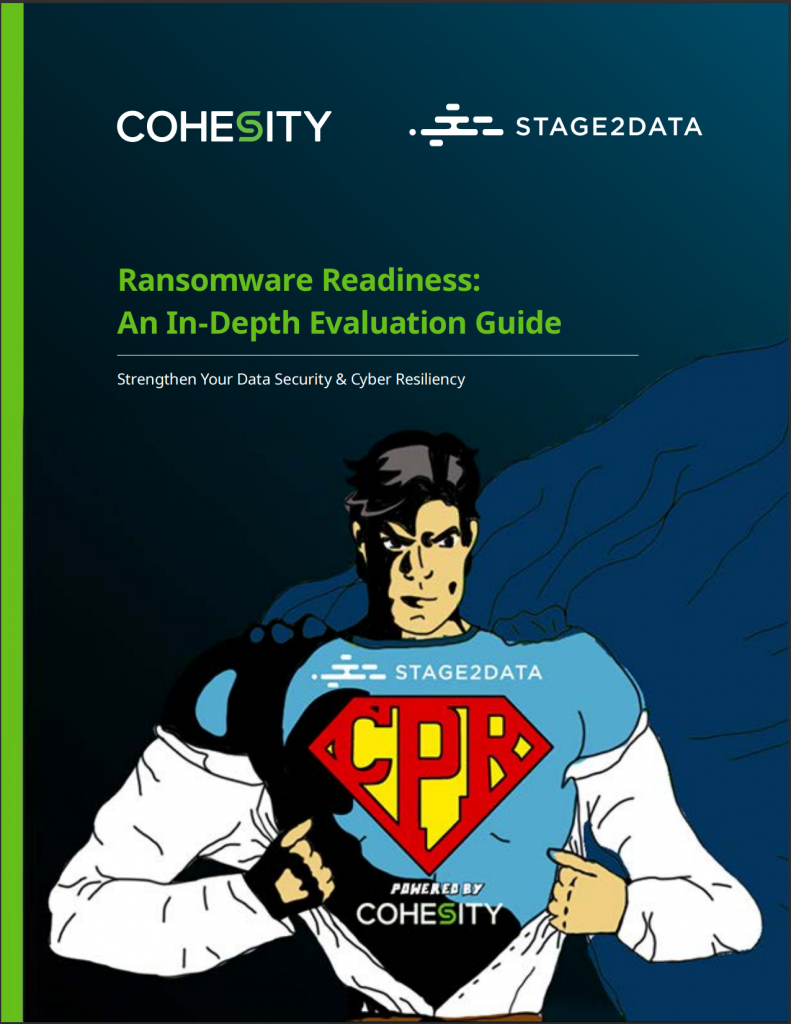
Download Ransomware Readiness: An In-Depth Evaluation Guide
Our Spring Sale Has Started
You can see how this popup was set up in our step-by-step guide: https://wppopupmaker.com/guides/auto-opening-announcement-popups/